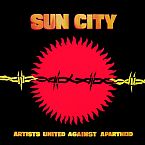
Sun City was a resort in South Africa that catered to wealthy white tourists. Many famous entertainers performed there despite the racist apartheid policy. Artists United Against Apartheid was organized by "Little Steven" Van Zandt, who discovered Sun City when he traveled to Africa after leaving Bruce Springsteen's E Street Band in 1985.
Van Zandt considered naming artists who played the Sun City resort in the song, but decided not to. He asked them to participate in the project instead.
Bruce Springsteen, Peter Gabriel, Miles Davis, Bob Dylan, Run-D.M.C., Lou Reed, Bonnie Raitt, Bono, Melle Mel, Keith Richards, Jackson Browne, and George Clinton are some of the 54 artists who contributed to the song. A mix of music styles, including rap, rock, and jazz were incorporated.
This was one of the first collaborations among major recording stars to support a political, rather than a social cause. The project raised over $1 million dollars for anti-apartheid efforts.
Hip-hop pioneer Kurtis Blow was one of the musicians who performed on this collaboration. He
told Songfacts about the experience: "That was a blessing, just incredible. Stevie calls everybody together. He calls me up and says, 'Hey I want you to do this song about the plight in South Africa. We're not going to play Sun City and we want everybody to know about the injustices that are going on down there. We need to let everyone know that we're not happy and we're not going to play in South Africa until things are changed over there.' Stevie Van Zandt was united in this thing. We jumped at the chance to be a part of it. It was too strong a cause for us to turn down. Then you have this white cat who's doing it, this is really what America stands for. A lot of people opened their eyes when that song came out."
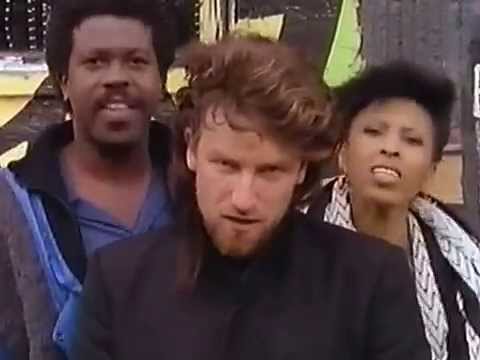
This was recorded at a series of sessions in four cities as artists would come by and contribute what they could, often improvising in their own styles. While most of the musicians didn't record together, many of them got together for the video, which was shot in different places around New York City.
The project was originally going to be one song, but some of the musicians contributed other pieces, making it into a full length album.
Most radio stations refused to play this because it did not fit a specific format and was politically sensitive.
The legacy of this song is that it helped expose apartheid, a system of forced discrimination in South Africa. Apartheid ended there in 1990 when Nelson Mandela was released from prison.
Backed by Simple Minds, Van Zandt played this song at the Free Nelson Mandela Concert at Wembley Stadium on June 11, 1988, where he was joined on stage by Peter Gabriel, Jackson Browne, Meat Loaf and Youssou N'Dour. In 1990, two months after Mandela was freed from prison, another concert was held in Wembley, this one dubbed Nelson Mandela: An International Tribute for a Free South Africa. Once again, Van Zandt did "Sun City," this time joined by Gabriel, N'Dour, Lou Reed, Chrissie Hynde, Patti LaBelle, Bonnie Raitt, Terence Trent D'Arby, Billy Bragg and Neneh Cherry.
Steven Van Zandt told Mojo the story of the song and how it became an entire album:
"On my list of things to investigate, one of the many issues the US was engaged in was South Africa. I went down there to do research in '84, to see it firsthand. It was so shocking that I said, 'This needs to be its own song, but it's not going to be just another song on my third album (1987's) Freedom - No Compromise. I need this to be its own thing and get some attention. I was gonna maybe have five or six artists on it, then it turned into 50 artists. I only had the one song written. We were trying to talk people into coming in to record, in all different hours of the night.
Miles Davis came in - we had a log drum throughout the song for five, six minutes, and he just improvised to this log drum for five minutes! Then he did more with the mute. In the song, I was using him for six seconds in the intro, then another five seconds in the middle - so I need him for 11 seconds, and I have five minutes, I'm like, 'No f--- king way am I leaving Miles Davis on the floor,' so we bought in Herbie Hancock and Tony Williams and Ron Carter, who have played with him in the old days, and they improvised to what he had improvised.
Peter Gabriel started ad-libbing these orchestral vocal things out of nowhere. So we put drums on top of that and that became a cool thing in itself. So before you know it, we had an album, and it became quite a thing."