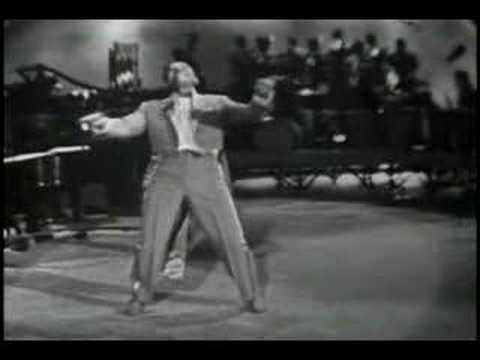
"Minnie the Moocher" was written by the famous band leader, jazz composer and singer Cabell "Cab" Calloway III, and the jazz music publisher Irving Mills. It was first recorded in 1931 by Cab Calloway and His Orchestra, and became their signature song for the next decade. Beloved by audiences, "Minnie the Moocher" earned Calloway the nickname "The Hi De Hi De Hi Man" based on his unique form of scatting in the song.
The song tells the sad story of a "red hot hoochie coocher" girl called Minnie. The hoochie coochie was a style of belly dancing with non-respectable gypsy origins, and was considered lecherous at the time. The licentious Minnie gets involved with a "kokie" conveniently called Smokey, a "kokie" being someone who takes cocaine. Smokey takes her down to Chinatown where he introduces her to opium, which is what Calloway meant when using the jive expression "to kick the gong around" in the lyrics. The rest of the song describes her opium-induced wish-fulfillment fantasy in which the king of Sweden gives her many gifts, including "a diamond car, with the puh-latinum wheels." Calloway doesn't tell us how this story ends, but he does wail "Poor Min! Poor Min" Poo-oor Min" at the end, which may be an indication that Minnie's a goner.
"Minnie the Moocher" is riddled with jive slang most white listeners of the time didn't understand. So, although it is quite a sordid tale, the song was not censored and reached a very wide audience, selling more than a million copies.
Calloway became an authority on this jive and was highly enthusiastic about the subject; in 1944 he published a dictionary of the Harlem patois called The New Cab Calloway Hipster's Dictionary: Language of Jive.
What made this song so special to audiences was the call-and-response scat battle that Calloway used to engage them when performing it at the Cotton Club and other famous jazz nightclubs in Chicago. He would start off with "he de hi de hi de hi," and simple variations, which the audience could repeat back easily, but then his scats would get steadily more difficult until finally he would give them a "Skeedle-a-booka-diki biki skeedly beeka gookity woop!" to respond to, leaving most people far behind in fits of laughter. This form of scatting became Calloway's trademark, and he wrote many more songs in a similar vein, including "The Hi-De-Ho Miracle Man," and "You Gotta Hi-De-Ho."
"Minnie the Moocher" has very strong musical and lyric similarities with a contemporary song called "Willie the Weeper," written in 1927 by the singer and Frankie "Half-Pint" Jaxon. The song has been recorded and performed most notoriously by Billy Walker, Louis Armstrong and Dave van Ronk. "Willie the Weeper" is also about drug addiction and an ensuing dream, but instead of the king of Sweden, Willie dreams of his adventures with the Queen of Sheba, Cleopatra, and the sultan of Turkey. Irving Mills openly quoted lyrics from the song when he said that Minnie "had a million dollars in nickels and dimes; she sat around and counted it all, a million times," whilst Willie also "had a million dollars, all in nickels and dimes… Well he knew it 'cause he'd counted them a million times."
In 1932 Calloway's music and dance steps were used in a Talkartoon short cartoon with Betty Boop entitled Minnie the Moocher, where his movements were transformed into those of a ghostly singing walrus through the technique of rotoscoping. At the beginning of the short, he is filmed dancing to the introduction of the song, and this is the earliest existing recorded footage of Calloway.
In 1999 "Minnie the Moocher" was given a Grammy Hall of Fame Award.
Calloway's performance of "Minnie the Moocher" in the classic 1980 film
Blues Brothers, directed by John Landis, was his final movie appearance, although he lived for another 14 years and kept on performing right to the end. Calloway's scene is a highlight of the film, although we find it hard to choose between "Minnie" and Aretha Franklin's spirited performance of "
Think."
Both these scenes came as a pleasant surprise, like a distantly recalled memory of a song you once knew but had forgotten all about. For some, it was an all-important first exposure to a musical heritage never to be repeated. In the film, Calloway appears at the climax and saves the Blues Brothers' gig, for which they are late, having run into some trouble with the law. He stalls the audience by entertaining them with a little "he-de-hi-de-hi." It's a point in the movie in which it becomes difficult to suppress a childlike feeling of glee, a definite high point.
In 2012, a
very emotive street performance of the song recorded in New York City's Union Square rocketed the Danish band Brothers Moving to YouTube renown. The band had been around since 2008 with little exposure, but their performance of the song went viral and ran up over 25 million views, making it the most popular "Minnie The Moocher" video on the platform.