The words and imagery of this song represent the life, work, and death of Vincent Van Gogh. The opening line, "Starry, starry night," refers to
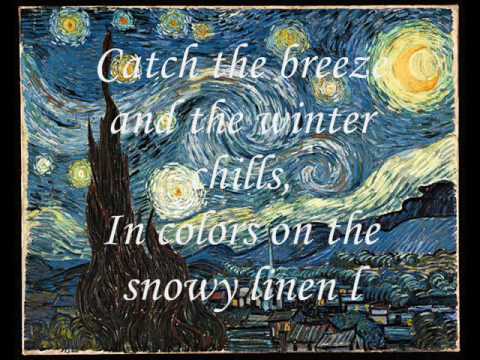
A Starry Night, one of the Dutch impressionist's most famous paintings.
The lyrics, "Paint your palette blue and gray" reflect the prominent colors of the painting, and are probably a reference to Vincent's habit of sucking on or biting his paintbrushes while he worked. The "ragged men in ragged clothes" and "how you tried to set them free" refer to Van Gogh's humanitarian activities and love of the socially outcast as also reflected in his paintings and drawings. "They would not listen, they did not know how" refers to Van Gogh's family and some associates who were critical of his kindness to "the wretched."
"How you suffered for your sanity" refers to the schizophrenic disorder from which Van Gogh suffered.
>>
Suggestion credit:
Bruce - West Columbia, SC
Don McLean told The Daily Telegraph February 24, 2010 the story of this song: "In the autumn of 1970 I had a job singing in the school system, playing my guitar in classrooms. I was sitting on the veranda one morning, reading a biography of Van Gogh, and suddenly I knew I had to write a song arguing that he wasn't crazy. He had an illness and so did his brother Theo. This makes it different, in my mind, to the garden variety of 'crazy' - because he was rejected by a woman [as was commonly thought]. So I sat down with a print of Starry Night and wrote the lyrics out on a paper bag."
McLean was going through a dark period when he wrote this song. He explained to The Daily Telegraph: "I was in a bad marriage that was torturing me. I was tortured. I wasn't as badly off as Vincent was, but I wasn't thrilled, let's put it that way."
This song, and Van Gogh's painting, reflect what it's like to be misunderstood. Van Gogh painted "Starry Night" after committing himself to an asylum in 1889. He wrote that night was "more richly colored than the day," but he couldn't go outside to see the stars when he was committed, so he painted the night sky from memory.
Talking about the song on the UK show Songbook, McLean said: "It was inspired by a book. And it said that it was written by Vincent's brother, Theo. And Theo also had this illness, the same one Van Gogh had. So what caused the idea to percolate in my head was, first of all, what a beautiful idea for a piece of music. Secondly, I could set the record straight, basically, he wasn't crazy. But then I thought, well, how do you do this? Again, I wanted to have each thing be different.
I'm looking through the book and fiddling around and I saw the painting. I said, Wow, just tell the story using the color, the imagery, the movement, everything that's in the painting. Because that's him more than he is him.
One thing I want to say is that music is like poetry in so many ways. You have wit and drama and humor and pathos and anger and all of these things create the subtle tools that an artist, a stage artist, a good one, uses. Sadly, this has really gone out of music completely. So it makes someone like me a relic, because I am doing things and people like me are doing things that utilize all the classic means of emotional expression."
There could be some religious meaning in this song. McLean is a practicing Catholic, and has written songs like "Jerusalem" and "Sister Fatima" that deal with his faith. The "Starry Night" could mean creation, with many of the other lyrics referring to Jesus. McLean has said that several of the songs on the American Pie album have a religious aspect to them, notably the closing track "Babylon."
The
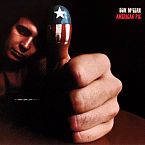
American Pie album is best known for the
title track, which vaulted McLean from little-known folk singer to major recording artist. The song "American Pie" caught on quickly and rose to #1 in America on January 15, 1972, staying at the top for four weeks. "Vincent" was the next single, and a substantial hit, going to #12 in May. Importantly, it showed McLean's depth as a songwriter and performer, and ensured he could never be a one-hit wonder.
The sudden success was great for McLean financially (he bought a Mercedes, not a Chevy), but difficult in terms of expectations. "Everything was on my shoulders," he
told Songfacts. "I am a strong person, but a lot came down at once. You had this #1 record. Now you've got to start working and proving yourself. It's a hard job. Most people don't realize how hard it is. It's a grueling schedule and you have to be nice all the time. You have to succeed on stage all the time and you have to make recordings that are very good all the time, otherwise you're done."
The British electronic artist Vincent Frank aka Frankmusik (check out "
Better Off as Two") was named after this song.
The Irish singer Brian Kennedy sang this song at footballer George Best's funeral.
According to the movie Tupac, the Resurrection, Gangsta rapper Tupac Shakur was influenced by Don McLean, and this was his favorite song. When he was fatally wounded in a drive-by shooting in 1996, his girlfriend put this tune into a player next to his hospital bed to ensure it was the last thing he heard.
Underneath the Van Gogh museum in Amsterdam, there is a time capsule that contains the sheet music to this song along with some of the artist's brushes. This song is often played at the museum.
This soundtracked the moment on the "'Scuse Me While I Miss the Sky" episode of The Simpsons when Lisa becomes interested in astronomy.
Josh Groban included the song on his self-titled debut album, which was released in 2001 when he was just 20 years old.