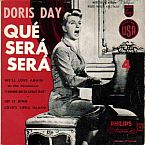
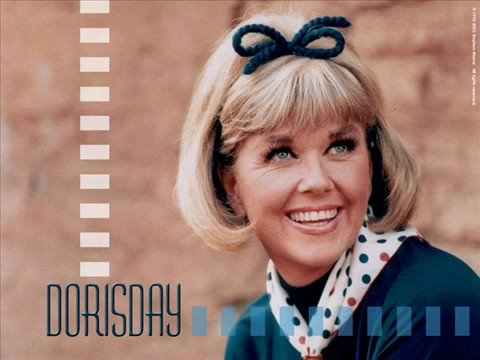
Running just 2:01, this song points out, quite effectively, how we can't predict the future. The first of the three verses finds Doris Day asking her mother if she'll grow up to be pretty and rich. Instead of the stock parental reply of "you can be anything you want to be," her mother comes back with something much more profound: whatever will be, will be.
In the next verse, she asks the man she loves if they will live a happy life together, and he gives her the same answer. In the last verse, she has kids of her own and imparts this same wisdom.
This was written by Ray Evans and Jay Livingston, who wrote many songs for movies when they were under contract with Paramount Pictures. Doris Day sang it in Alfred Hitchcock's 1956 remake of his 1934 film
The Man Who Knew Too Much. In the film, she was putting her young son to bed. Livingston told Paul Zollo in 1987: "We got a call from Alfred Hitchcock. And he told us that he had Doris Day in his picture, whom he didn't want. But MCA, the agency, was so powerful that they said if he wanted Jimmy Stewart he would also have to take Doris Day and Livingston and Evans. It was the only time an agent got us a job that I can remember. Hitchcock said that since Doris Day was a singer, they needed a song for her. He said, 'I can tell you what it should be about. She sings it to a boy. It should have a foreign title because Jimmy Stewart is a roving ambassador and he goes all over the world." (this appears in Zollo's book
Songwriters On Songwriting)
The phrase "Que Sera, Sera" came from a 1954 movie called The Barefoot Contessa, where the family motto of the character played by Rossano Brazzi is "Che Sera, Sera." The motto in the film is Italian, but Evans and Livingston switched the "Che" to "Que" because more people spoke Spanish in the US.
This became Doris Day's biggest hit and her signature song, but she didn't want to record it because she thought of it as a children's song. Livingston explained in Zollo's interview: "She didn't want to record it but the studio pressured her. She did it in one take and said, 'That's the last you're going to hear of this song.'"
This song has been reworked and updated by various artists over the years. A group called The High Keyes did a rock version from a male perspective that reached #47 US in 1963. Mary Hopkin did a jaunty rendition that went to #77 in 1970.
One of the most intriguing covers came in 1973 when Sly & the Family Stone did a slow, mellow version running 5:23. Sly Stone and Doris Day reportedly crossed paths at the mansion of music producer Terry Melcher, Day's son, and Sly played her "Que Sera, Sera" on the piano. The story of their meeting got out in the press, and when Sly & the Family Stone covered the song, rumors - likely fueled by the record company looking to goose sales - kicked in that they were having an affair.
The song has also been recorded in different languages, including Polish (by Renata Bogdanska), Mandarin (by Grace Chang) and Italian (by Ricchi e Poveri).
Ray Evans and Jay Livingston also wrote the theme song to the TV show
Mr. Ed, which is about a talking horse (Livingston sang on that one). Some of their other compositions include "
Mona Lisa" and the Christmas classic "Silver Bells."
This song won the 1956 Oscar for Best Song. In addition, Doris Day's character sang it to herself in a scene from the 1960 film
Please Don't Eat the Daisies, and the song later became the theme song for her sitcom
The Doris Day Show, which ran from 1968-73.
>>
Suggestion credit:
Jerro - New Alexandria, PA
Two different versions of "Que Sera, Sera" are used in the 1989 movie Heathers. It opens with a version by the female singer Syd Straw, and closes with Sly And The Family Stone's rendition. Other movies to use the song include:
Seven Pounds (2008)
Mona Lisa Smile (2003)
28 Days Later... (2002)
Nurse Betty (2000)
Girl, Interrupted (1999)
Why Do Fools Fall in Love (1998)
Private Parts (1997)
Ed Wood (1994)
Waiting (1991)
Back To The Beach (1987)
Please Don't Eat the Daisies (1960)
And in these TV shows:
Scream Queens ("Chainsaw" - 2015)
Scandal ("Honor Thy Father" - 2015)
Sabrina the Teenage Witch ("Sabrina the Matchmaker" - 1999)
Ally McBeal ("Happy Birthday, Baby" - 1998)
Happy Days ("In the Name of Love" - 1974)