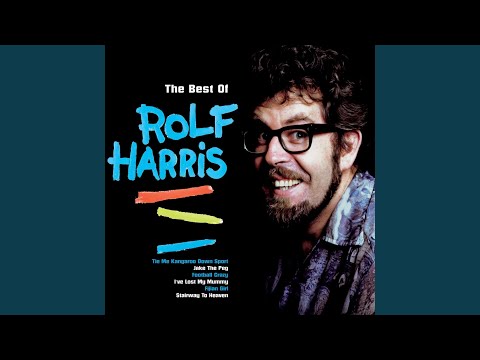
Harris wrote this song about an Australian stockman on his deathbed in 1957. He was inspired by the Harry Belafonte calypso craze, which was big at the time, and he wrote this as an Australian calypso. Harris recalled in
The Wacky Top 40 by Bruce Nash and Allan Zullo: "I was trying to come up with new songs that had a simple chorus that everybody in the club could join in with. I liked (Harry Belafonte's) 'Hold 'Em Joe.' There was a line that went, 'Don't tie me donkey down there, let him bray, let him bray.' And I thought, 'That's good. I can change that and make it an Australian calypso. Instead of a donkey, I'll have a kangaroo in there somewhere.' "Eventually, I came up with 'Tie me kangaroo down, sport.' And the tune seemed to come from midair. It was just handed to me on a plate." Harris proceeded to write as many verses as he could think of regarding Australian themes. It was his brother Bruce that came up with the idea of tying all the verses together into a story about a dying rancher.
When it was released in 1960, the song went to #1 in Australia for four weeks and reached #3 in the UK. That same year, it was released in America on 20th Century Fox, but went nowhere. Three years later it was released in the US after an Aborigine-inspired song called "Sun Arise" made it to #61 there. Harris recalled: "A disc jockey in Denver played 'Tie Me Kangaroo Down, Sport' for a laugh. He told his audience, 'I don't understand the lyrics and I don't know what a didgeridoo is.' He got such a reaction to the song that he played it almost every hour. So Epic Records put it out as a single and it became a hit."
The American version was produced by George Martin, who went on to fame producing The Beatles.
The whoop-whoop-whoop sound in the background came from a wobbleboard, which is basically a sheet of masonite. Originally Harris used the wobble board for his painting before he discovered its musical properties by chance. This happened when he shook one to cool it down after it had been propped up by a paraffin heater and he discovered when he did this it produced an interesting sound.
When Harris wrote this song, many Aborigines were treated as no better than slaves, and the original words that Harris wrote for the song included a verse referring to Aboriginal workers in those terms. Some territories picked up on it and the song was banned in Singapore. Harris has since admitted that those lines were racist and apologized for using such language. The Australian singer-songwriter later dropped the verse when re-recording the hit for the American market. He explained in an interview with Radio Scotland in 2006: "I was 27 or something when I wrote that. But since 1960, I have never sung that verse."
In May 1963, Pat Boone released a cover of this song as a single, which competed with the re-release of Harris' version in America. Boone's cover didn't dent the charts, as Harris stayed in the Top 40 for nine weeks that summer.
Rolf Harris recalled to The NME: "Pat Boone was in Australia when it was a hit in 1960. He wanted to do an American version but his record company said, 'It doesn't make any sense.' Three years later I had a #3 in America. Pat Boone went back and said, 'See.'"
Harris performed this song with The Beatles for BBC radio in 1963. His adapted lyrics included; "Don't ill-treat me pet dingo, Ringo/ Don't ill-treat me pet dingo/ He can't understand your lingo, Ringo, So don't ill-treat me pet dingo, Ringo."
When a sprightly eighty year old Rolf Harris appeared on the BBC
Breakfast programme on Friday, June 18, 2010 to promote his latest book and art exhibition, he was asked by one of the presenters how he got into music. Harris moved to London from his native Australia in 1952 to study art; his ambition was to become a portrait painter, but as he told Charlie Stayt and Susanna Reid: "Well I was broke, I ran out of money..." which led to him entertaining, playing piano accordion in the
Down Under club, which was patronised by Australians and New Zealanders. He wrote the song for them.
>>
Suggestion credit:
Alexander Baron - London, England
In America, Harris released spin-off songs called "Tie Me Hunting Dog Down, Jed" and "Tie Me Surfing Board Down Sport."
In the late '80s there was a WWE wrestler named Outback Jack who used "Tie Me Kangaroo Down, Sport" as his theme song. He really was Australian, and that was his angle, playing to Aussie stereotypes at a time when the Crocodile Dundee movies were big.