The title is Latin for "Glory," and the Latin refrain of "In Te Domine" means "In You Lord." (Did you know: Bono's stage name was originally Bono Vox, which is Latin for "Good Voice"). Like all but the most scholarly among us, Bono is not fluent in Latin. He did know some Latin words - mostly because of church - and with tape rolling, he sang what came to him. The challenge then was to translate what he had sung, so he left the studio to find a Latin dictionary but found something better: a friend who had studied the language and could translate for him.
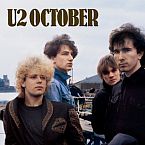
Released on U2's second album, October, "Gloria" is a spiritual song reflecting the Christian beliefs of Bono, The Edge, and Larry Mullen (bass player Adam Clayton was not as devout). Early on, U2 infused worship messages in their songs, and almost broke up the band when they feared it conflicted with their faith.
With lyrics like, "I try to stand up, but I can't find my feet," Bono is supplicating to a higher power. He explained to Musician magazine in 1983: "I had this feeling of everything waiting on me, and I was just naked, nothing to offer. So I went through this process of wrenching what was inside myself outside of myself."
Some of Bono's lyrics and vocals were inspired by an album of Gregorian chants that their manager, Paul McGuinness, had given him.
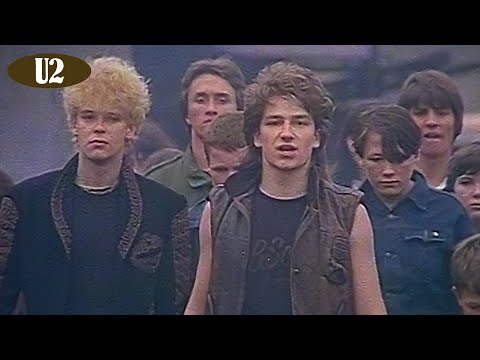
The music video was the second from U2 (following "
I Will Follow") and their first in the MTV era. Directed by Meiert Avis, it shows the band performing the song in Dublin in the same place the October album cover was shot. It was the first U2 video shot outdoors, something they did on many others over the next few years because they liked the lighting.
Adam Clayton played a bass solo on this track, something he rarely did.
Bono likes how the title is the name of a woman, but with a different meaning. He explained in the book
Race Of Angels: "I actually really like that lyric. It was written really quickly. I think it expresses the thing of language again, this thing of speaking in tongues, looking for a way out of language. 'I try to sing this song... I try to stand up but I can't find my feet.' And taking this Latin thing, this hymn thing. It's so outrageous at the end going to the full Latin whack. That still makes me smile. It's so wonderfully mad and epic and operatic. And of course Gloria is about a woman in the Van Morrison sense. Being an Irish band, you're conscious of that. And I think that what happened at that moment was very interesting: people saw that you could actually write about a woman in the spiritual sense and that you could write about God in the sexual sense. And that was a moment. Because before that there had been a line. That you can actually sing to God, but it might be a woman? Now, you can pretend it's about God, but not a woman!"
>>
Suggestion credit:
Bertrand - Paris, France
"Gloria" was modestly successful throughout Europe but in America was mostly constrained to college radio stations and didn't chart. Most listeners heard it for the first time on the Under A Blood Red Sky live album, which was released in 1983 after U2's third album, War, took off. "Gloria" was the only track from October included on the album, and along with "Party Girl," one of two songs on the tracklist recorded June 5, 1983 at the Red Rocks amphitheater in Colorado.
U2 played "Gloria" at concerts throughout the '80s but mothballed it until 2005, when it returned for their Vertigo tour. They brought it back again in 2015 for their Innocence + Experience tour.
Van Morrison released an unrelated
song called "Gloria" in 1964 with his band Them. A fellow Irishman whom U2 admired, Morrison's "Gloria" is a rock classic about woman so compelling, Van has to spell out her name to make his point: "G-L-O-R-I-A!"
In 1975, Patti Smith released a song called "
Gloria: In Excelsis Deo" that's a quasi cover of Them's song mashed up with the hymn "Gloria in Excelsis Deo" to take a stab at the Catholic church. The opening line is:
Jesus died for somebody's sins but not mineA
less complicated "Gloria" was popularized in 1982 by Laura Branigan, but that song was first released in Italian by Umberto Tozzi in 1979, so it pre-dates U2's "Gloria."
In 2003, Brand New toyed with the Latin interpretation on their song "
Sic Transit Gloria... Glory Fades."
Steve Lillywhite produced this song along with the first three U2 albums. He had form for getting the most out of young bands with audacious lead singers: He also produced the first two Psychedelic Furs albums around this time.
"Gloria" is by far the most enduring song from the
October album, which started to unravel when Bono lost his notes and lyrics, leaving them behind at a 1981 concert in Portland, Oregon. But also, Bono, The Edge and Larry Mullen were under pressure from a very dogmatic religious group they joined called the
Shalom Fellowship, which had a faction pushing them to break up the band in service to God. They ended up choosing the band over the Fellowship, but it was a close call.