Vertigo is a sensation of dizziness or a feeling of disorientation. It can be a serious medical condition, but in the context of this song, it's about opening your mind and looking at things in a different way.
The song was
used in commercials as part of a big promotional deal with Apple. The spots, where many people first heard the song, promoted Apple's iPod, which was introduced in 2001 and on its fourth generation. Apple released a special-edition iPod as part of the promotion that was the first of its kind that wasn't white - the U2 version had a red wheel and was black. A later edition came with the signatures of the band members engraved on the back and made the entire U2 catalog along with special bonus tracks available for download at iTunes for $150.
This song is instantly identifiable by its intro, where Bono says "Uno, dos, tres, catorce," which is "1, 2, 3, 14" in Spanish. One theory is that Bono was directing listeners to The Bible: 1st Testament, 2nd Book, 3rd Chapter, 14th verse - "And God said unto Moses, I AM THAT I AM: and he said, Thus shalt thou say unto the children of Israel, I AM hath sent me unto you." Another theory is that he did it because How To Dismantle An Atomic Bomb was U2's 14th album.
The unconventional count-in certainly jells with the vertiginous nature of the song, which seems to be the point.
According to Bono, "Vertigo" captures the band's live energy better than any other song. He credits the track's producer, Steve Lillywhite, for making this happen. Lillywhite told them to play the song in the studio like they were playing a small club.
Lillywhite produced U2's first three albums, then returned for How To Dismantle An Atomic Bomb. He was one of the few people in 2004 who could get the band into the mindset they had in the early '80s when they were frothy upstarts.
The bridge, where Bono sings, "All of this can be yours," represents a temptation by the devil. After the line, "Just give me what I want and no one gets hurt," the song screeches to a halt and then the chorus kicks back in.
"To be a man of the world but not this one is, I guess, the idea behind the song," Bono wrote in his memoir Surrender. "You get the sense that the singer is not sure if that's possible but he's gonna try as hard as hell. In the end it's the bass that offers the devil denial, the bass that offers the great 'f--k off.'"
"Vertigo" was the lead single from U2's 11th album, How To Dismantle An Atomic Bomb. Per band tradition, the first to play it was Dave Fanning, a DJ at 2FM in Ireland who was an early supporter of the band. He debuted it on September 23, 2004. A day later, the song was sold in America as a limited-edition single and it was released to radio. The iPod commercial started airing October 12, and the song was released as a single worldwide on November 8, with the album following on November 23.
U2 made many high-profile appearances to promote the album, including performances on Saturday Night Live and the Grammy Awards. In the late '80s and early '90s, U2 often stayed away from these kind of appearances to avoid the feeling of commercialism, but by the 2000s, it became clear that these appearances were crucial if U2 was going to continue selling millions of albums and fill arenas.
Vertigo is also the name of a popular 1958 movie directed by Alfred Hitchcock, but the word had never been used in a charting song before this one.
"Vertigo" won three Grammy Awards: Best Rock Song, Best Rock Performance By A Duo Or Group With Vocal and Best Short Form Music Video. U2 performed on the show, but didn't play the song, opting instead for "
Sometimes You Can't Make It On Your Own," which Bono dedicated to his father.
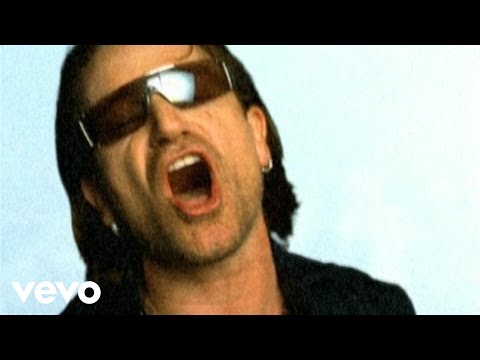
The music video was shot in Punta Del Fanga, Spain, and shows the band performing the song with vapor trails emitting from their backs. It was directed by the team of Alex and Martin (Alex Courtès and Martin Fougerol), who also did the visual for "
Seven Nation Army" by The White Stripes.
"Vertigo" is a live favorite for U2. In concert, Adam Clayton's bass is boosted, shaking stadiums to their foundations.
U2 played this when they were inducted into the Rock and Roll Hall of Fame in 2005.
This song was ruthlessly parodied on the
South Park episode "More Crap." The plot revolves around the character Randy Marsh breaking the world record for largest piece of crap, previously held by Bono. Cartoon Bono is shown throughout the episode trying to beat and then preserve this record. Almost everywhere he goes (including poor nations in Africa) he runs around pointing and singing his "yeah, yeah, yeah" outro of "Vertigo." He also answers his cell phone with the "Hello, hello" part of the chorus.
>>
Suggestion credit:
Bert - Pueblo, NM
This was originally called "Native Son" and had a very different feel. Adam Clayton explained to Q Magazine November 2004: "Bono and Edge rewrote it when we started work with Steve Lillywhite. The bass and drums have a little bit of Echo & the Bunnymen in there - a nice wink to where we came from."
Adam Clayton said of the
How To Dismantle An Atomic Bomb album: "It's very much a guitar record, 'Vertigo,' 'Love and Peace,' 'City of Blinding Lights,' 'All Because of You' - all pretty up, rocky tunes. A lot of them are a kick-back to our very early days, so it's like with each year we have gathered a little bit more and this is what we are now."
>>
Suggestion credit:
Bertrand - Paris, France
Bono has a hard time listening to his own voice and usually turns off the radio when a U2 track is played, but not when "Vertigo" comes on. "It's the way it connects with the crowd," he said on the
Awards Chatter podcast. "I've been in the car when one of our songs has come on the radio and I've been the color of, as we say in Dublin, scarlet. I'm just so embarrassed."
Bono's original lyrics for the song were a tribute to Leonard Peltier, a Native American activist convicted of murdering two FBI agents in 1975, and long the subject of miscarriage of justice campaigns. The band, initially working with producer Chris Thomas, were unhappy with how their recordings of "Native Son" and other tracks turned out. In January 2004, they brought in Steve Lillywhite to replace Thomas. During Bono's absence, the band re-recorded the backing track for "Native Son" with Lillywhite.
"For us, it was a complex lyrical matter," Adam Clayton told The Sun. "It wasn't really working and Steve called it. He said, 'Do a better backing track and then we'll play it to Bono.' He had been doing other work, but when he heard what we'd done, he was very excited. Bono said, 'Give me a mic.' And the bones of Vertigo happened right there."